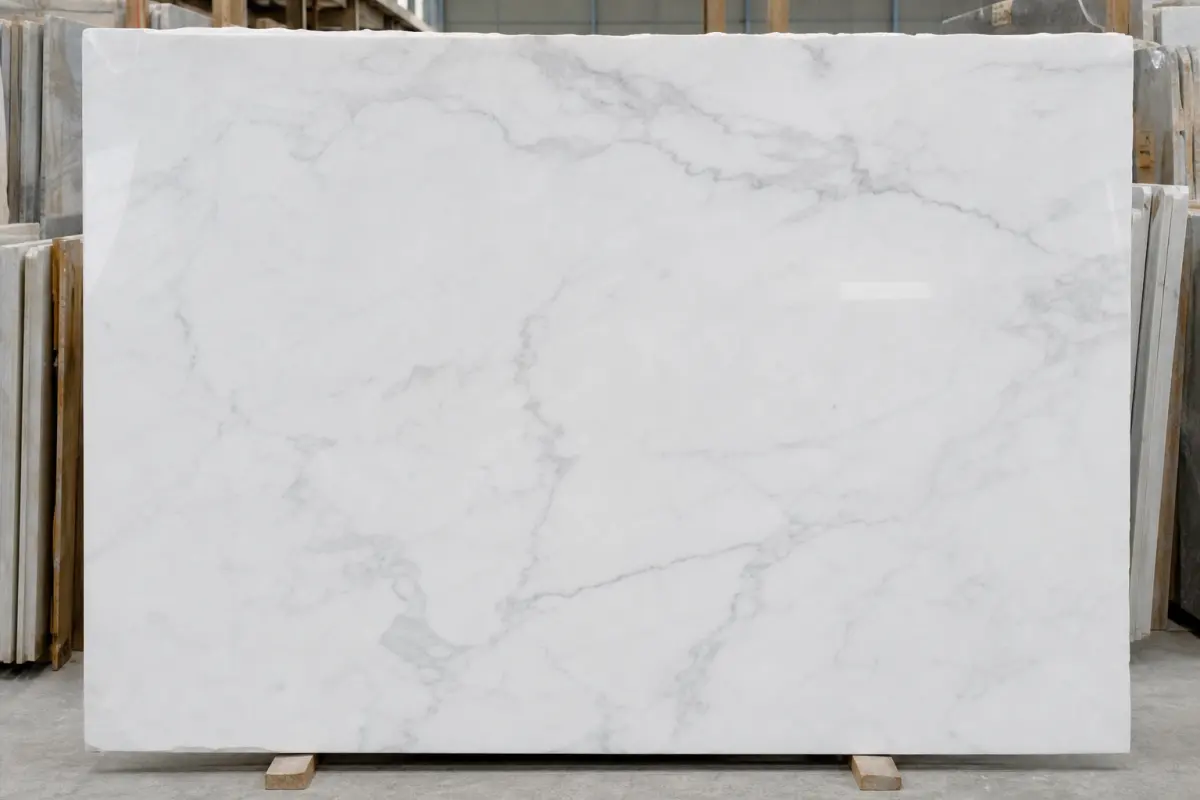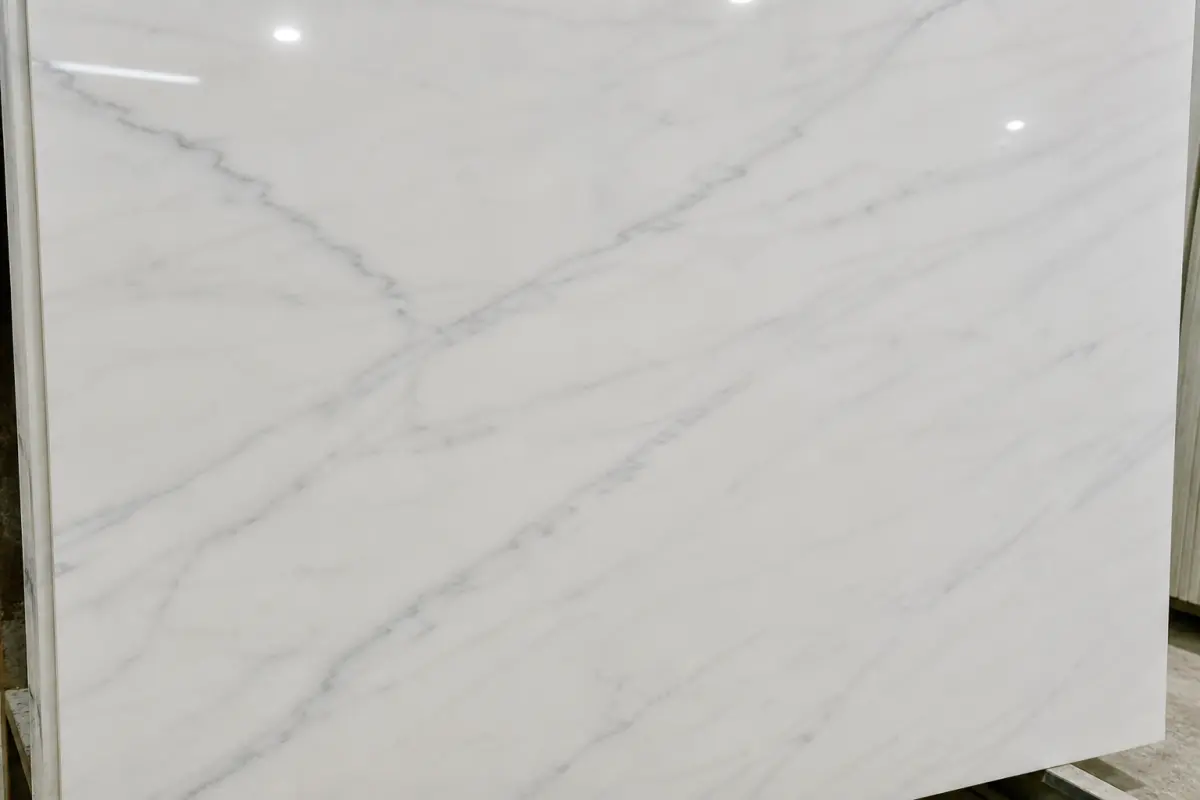
Architects often pit Super White Buner marble against Italian Carrara on sample boards. This buyer guide compares look, shade stability, landed cost, lead time, and when a Buner super-white slab is the smarter specification.
Sample boards in Lahore, Riyadh, and London often show two whites side by side: a slab stamped Carrara from Italy and a brighter piece labelled Super White Buner marble from Khyber Pakhtunkhwa. The conversation stops at “which is cheaper?”—but the better question is which white matches your shade band, timeline, and maintenance story after install. Carrara carries brand recognition; Buner super-white carries mill-gate proximity to hundreds of gangsaws and a royalty tier that already signals premium sorting in Pakistan.
Neither stone is “better” in the abstract. Carrara Bianco varieties offer centuries of quarry naming and predictable design-language for luxury hospitality brands. Super White from the Buner–Bampokha belt offers a cleaner, often higher-key background that some Gulf interiors prefer under warm LED lighting. Your job is to translate that visual preference into a specification engineers can buy without surprise at the loading dock.
Look: what architects actually compare
Carrara classics show grey feather veining on a white to blue-grey field. Super White Buner tends toward a whiter overall field with lighter, sometimes golden, veining depending on bench and block. Place both under your project’s lighting CCT—3000K lobby versus 4000K office—and photograph at arm’s length and at floor distance. Large-floor programmes read differently from reception desks.
Imported Carrara lots may arrive pre-selected by Italian bundle marks; Buner super-white relies on factory first-selection at the polish line. Ask both suppliers for bundle maps showing slab sequence from the same block if continuity matters. Cross-shop Super White Buner slabs with Bampokha No.1 if your Carrara alternative is really “bright white with controlled vein” rather than strict Bianco Carrara nomenclature.
Finish, thickness, and resin
Both materials ship most often at 2 cm polished for floor and wall. Honed Carrara is common in European spec; Buner factories can hone super-white but confirm scratch and stain protocol for high-traffic wet areas. Resin reinforcement and mesh backing appear on both when slab integrity requires it—list allowed repair area on your RFQ so Buner suppliers do not over-promise mirror perfection on calcite.
Cost: landed math beyond per-square-metre chatter
Ex-quarry or ex-mill pricing favours Buner when you buy factory-direct and accept Pakistan logistics. Italian Carrara adds European processing, ocean freight, and import duties at destination—often justified for brand-led luxury towers, painful for budget-sensitive regional hotels. Domestic Pakistani projects on super-white sometimes beat imported Carrara on total landed cost even when Italian material looks cheaper on a Dubai trader’s list price, because the list omits your port, your GST or VAT, and your inland haul.
Buner costs are not frozen in 2019. Federal sales tax on erstwhile PATA industrial supplies now phases toward 18 percent; factories pass that through on invoices. Our Buner factory tax research explains the ladder so you do not treat today’s quote like a tax-free PATA-era flyer. Power still matters: load shedding in Buner marble factories affects lead time, and rush premiums are real.
Block yield enters cost too. Wire-sawn Buner blocks recover more saleable area than blasted faces in the same commercial colour name. When a supplier prices super-white aggressively, ask extraction method—see blasting versus wire saw tools.
Lead time, documentation, and risk
Carrara from established Italian exporters offers familiar paperwork for banks and customs—if your importer has the relationship. Buner super-white offers shorter production cycles when slabs are in stock or when your order jumps a known factory’s queue—but container consolidation and Karachi port timing still apply for overseas jobs.
First-time Buner buyers should weight inspection and payment milestones more heavily than repeat Carrara importers. That is process risk, not geology. StoneVaults RFQs on the marketplace reduce chat fragmentation by forcing comparable thickness, finish, and quantity on each bid.
When to specify which white
- Specify Carrara when the owner or brand manual names Italian origin, or when the design narrative requires Bianco Carrara vocabulary.
- Specify Super White Buner when the priority is bright field, regional supply, and value on large square-metre counts with sample approval.
- Consider Bampokha No.1 when vein character can be slightly stronger but budget must stay below super-white royalty bands.
- Hybrid strategy Carrara in signature spaces, Buner white in back-of-house and room floors—common in hospitality value engineering.
Buy with eyes open
Super White Buner marble vs imported Carrara is not a morality contest—it is a specification and logistics contest. Nail lighting samples, tax-inclusive pricing, yield assumptions, and crate standards, then let factories compete on documented bundles. That is how Buner super-white earns Carrara-adjacent projects without pretending the names are interchangeable on a label.
Sample workflow that prevents swap-out at port
Ship a sealed master sample or high-resolution spectral reference from the bundle that will feed your container. For Carrara, importers often use bundle maps from Italian suppliers; for Buner super-white, request slab-sequence photos numbered to match crate stencils. Architects should sign off under two light sources—daylight and your installed LED spec—because white marbles shift visibly between 3000K and 4000K.
Maintenance belongs in the comparison. Calcite whites etch with acidic cleaners; both Carrara and Buner super-white need housekeeping rules on hospitality BOQs. If your operator expects aggressive mall cleaning chemicals, discuss honed or leathered alternatives and sealers with the factory before you blame origin for dull spots.
Repeat orders and shade continuity
Carrara repeat programmes lean on established quarry relationships. Buner repeat programmes lean on factory block contracts—reserve block marks early if a Gulf tower phases wings over eighteen months. Super-white royalty tiers mean the brightest benches cost more; locking block IDs protects shade better than reordering “same name” without paperwork.